Table of Contents
- What Leather Sofa Colour Matching Services Actually Do
- Leather Colour Matching from Photos: How It Works
- How to Repair Faded Leather Sofa Damage
- The Difference Between Leather Dye Colour Match and DIY Kits
- Understanding Leather Sofa Repair Cost and Value
- Common Challenges in Leather Colour Matching and How Professionals Solve Them
- Why Professional Leather Sofa Colour Matching Beats DIY Solutions
- Conclusion
- Frequently Asked Questions
Last Updated: 11 October 2026
What Leather Sofa Colour Matching Services Actually Do
Leather sofa colour matching services restore worn, faded, or damaged leather furniture to its original appearance. When a sofa develops patches, scuffs, or discolouration, professionals analyse the existing leather and apply pigments that blend seamlessly with the surrounding surface.
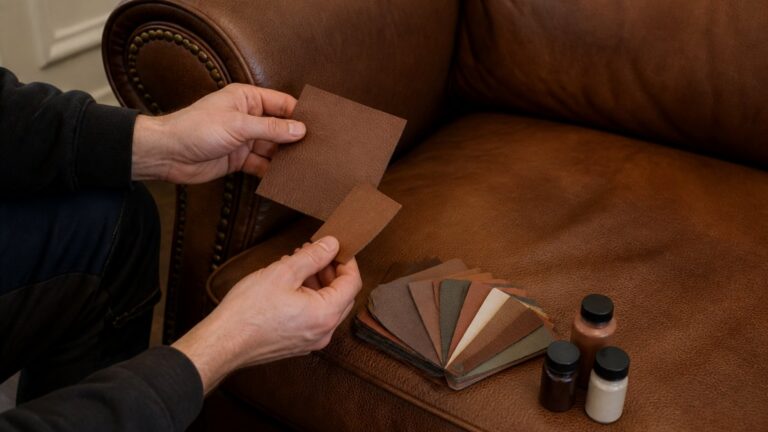
The process isn’t just about slapping on dye. A technician examines the leather’s texture, sheen, grain pattern, and exact shade. They then mix or select pigments to match precisely. The goal is invisible repair, work so well done that you can’t tell where the damage was.
At Uniqcare, we understand that your sofa isn’t just furniture. We understand that your sofa isn’t just furniture. It’s where your family sits, where you relax after a long day.
The best time to address leather damage is within the first few months. Leather that’s been worn for years develops a patina, a subtle colour variation across the surface. Matching that aged patina is harder than matching fresh leather.
Professional leather colour matching tackles several common problems:
- Faded patches where sunlight has bleached the leather
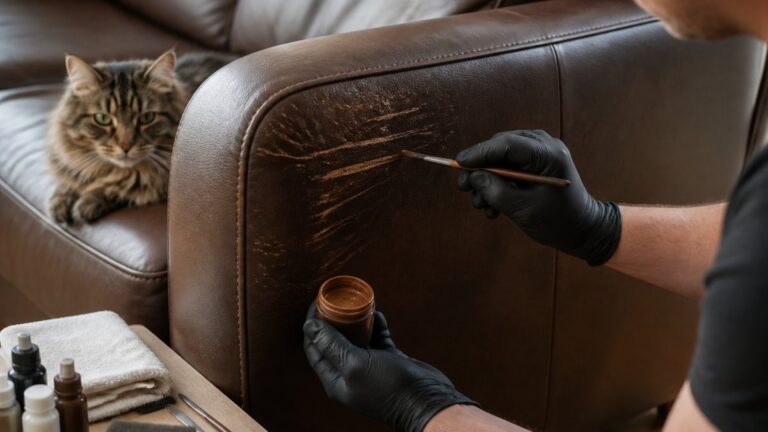
- Scuffs and scratches that expose lighter leather underneath
- Worn areas on armrests and seat edges
- Ink marks or stains that need colour correction
- Uneven wear across cushions
This is different from a basic repair. A basic repair might fill a hole. Colour matching makes that repair invisible by ensuring the pigment blends with the surrounding leather’s exact shade and finish.
Leather Colour Matching from Photos: How It Works
Can professionals truly match leather colour from a photograph alone? The short answer is: it depends on the photo quality, but most technicians need to see the leather in person.
A high-quality photo taken in natural daylight can give a technician a solid starting point. They can assess the general tone, whether the leather is warm or cool, and spot any obvious colour variations. But leather reflects light differently depending on the angle and lighting conditions. A photo taken under fluorescent bulbs looks completely different from one taken in daylight.
The real process works like this:
- Initial assessment from photos – You send clear images showing the damage and surrounding leather
- In-person colour analysis – The technician visits your home and examines the leather under natural light
- Pigment selection – They test small samples of dye on a hidden area or use colour-matching tools
- Application – Once the match is confirmed, they apply the pigment carefully to the damaged area
- Blending – They feather the edges so the repair transitions smoothly into the surrounding leather
Many people worry that colour matching will look patchy. That’s a legitimate concern if the work is rushed. The difference between a good match and a poor one comes down to technique and patience. A technician who takes time to blend the edges properly will produce work you can barely see.
Professional colour matching requires seeing the leather in natural light. Photos help, but they’re a starting point, not a substitute for an in-person assessment.
How to Repair Faded Leather Sofa Damage
Faded leather is one of the most common problems we see. Sunlight breaks down leather pigments over time. The damage is gradual, you might not notice it until one day you realise the armrest is significantly lighter than the rest of the sofa.
Repairing faded leather involves these steps:
- Clean the surface – Remove dust and oils so the new pigment adheres properly
- Assess the fade pattern – Determine whether the entire sofa is faded or just patches
- Match the surrounding colour – The goal is to bring the faded area back to match the rest of the leather
- Apply pigment gradually – Multiple thin coats work better than one thick coat
- Seal the repair – A protective coating locks in the colour and shields against future fading
The tricky part is matching faded leather because the rest of the sofa may have faded too. A technician needs to decide: are we matching the current colour of the sofa, or restoring it to its original shade? Usually, matching the current colour makes more sense. Trying to restore something to a shade it had years ago often looks artificial.
Sunlight exposure is the main culprit, but heat also accelerates fading. Leather near a radiator or in direct sunlight deteriorates faster. Once fading happens, prevention becomes important. Using furniture covers or repositioning the sofa away from direct light slows future damage.
The Difference Between Leather Dye Colour Match and DIY Kits
Here’s where many people make a costly mistake: they buy a DIY leather repair kit from a DIY store and try to fix the problem themselves.
DIY kits have several limitations:
- One-size-fits-all pigments – The dyes included rarely match your specific leather shade
- Poor adhesion – Without proper surface preparation, the dye sits on top of the leather rather than bonding with it
- Visible patches – Most DIY applications look obviously repaired because the colour doesn’t blend naturally
- Temporary results – The dye often flakes or fades within months
A professional leather dye colour match works differently. The technician uses colour-matching technology or years of experience to identify the exact pigment needed. They prepare the leather surface properly, apply the dye in thin layers, and blend the edges so the repair disappears.
One customer told us they’d tried a DIY kit before calling us. The patch they applied was darker than the surrounding leather and started peeling within weeks. We had to remove the failed repair and start fresh. The total cost ended up higher than if they’d called a professional initially.
DIY kits often make damage worse by creating visible patches or causing the dye to peel. What looks like a money-saving solution frequently costs more to fix later.
Professional work also comes with expertise. A technician can spot whether the leather is aniline (dye-penetrated), semi-aniline (dye plus protective coating), or pigmented (fully coated). Each type requires different treatment. Getting this wrong means the repair won’t match or won’t last.
Understanding Leather Sofa Repair Cost and Value
The question everyone asks: how much will this cost?
The honest answer is that leather sofa repair cost depends on several factors:
- Size of the damaged area
- Type of damage (small scuff vs. large tear)
- Leather type and how difficult it is to match
- Whether the repair needs structural work or just colour matching
- Your location and the technician’s travel time
We can’t quote you a price without seeing the damage in person. What we can tell you is this: professional repair can be a cost-effective alternative to replacing the sofa.
There’s also the value question. Your sofa isn’t just an object, it’s part of your home. If it’s a piece you love, restoring it makes sense emotionally and financially. If it’s an old sofa you’ve been thinking about replacing anyway, repair might not be worth it.
Many customers find that repair extends the life of their furniture by several years. A sofa that looked damaged and worn suddenly looks cared-for again. That matters if you’re planning to sell your home or just want your living room to feel pleasant.
At Uniqcare, we’ll tell you honestly if repair makes sense for your situation. Sometimes that means recommending repair. Sometimes it means being honest that the sofa has reached the end of its useful life.
Common Challenges in Leather Colour Matching and How Professionals Solve Them
Several challenges come up regularly in leather colour matching work. Understanding how professionals handle them helps explain why DIY attempts often fail.
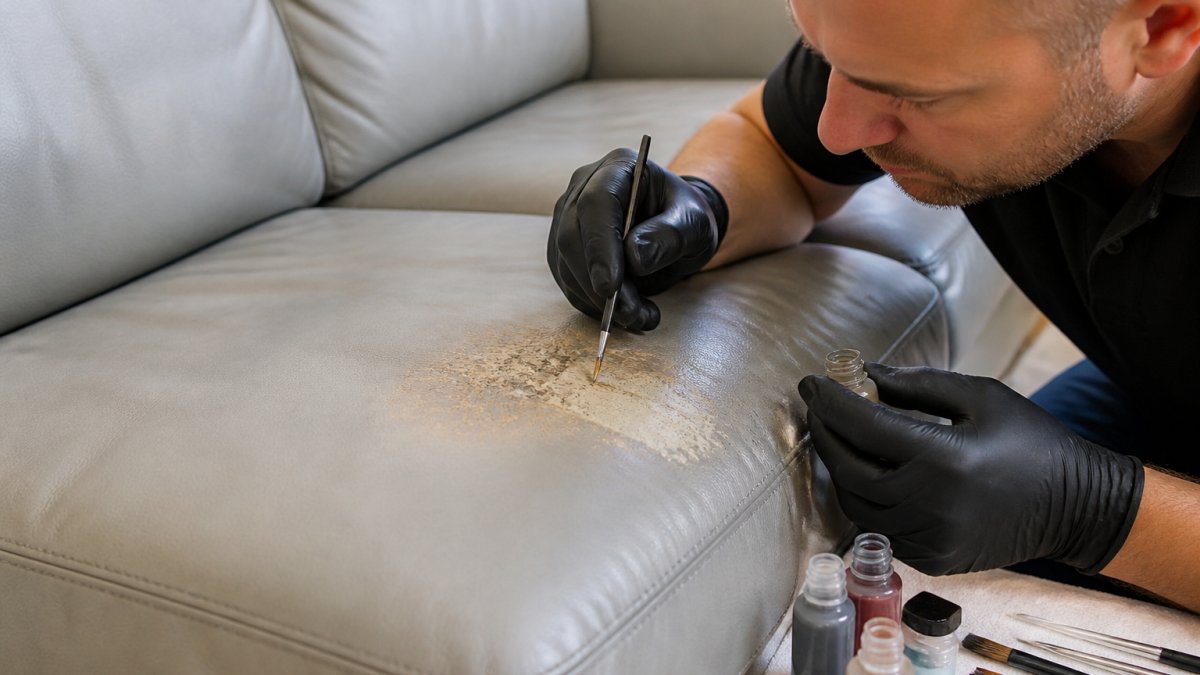
Challenge: Matching aged leather
Leather develops a patina over years. The colour isn’t uniform, it’s darker in creases, lighter on high points.
Solution: Professionals apply pigment in layers, creating depth that mirrors the aged leather.
Challenge: Texture mismatch
Leather has grain and texture. A repair that’s smooth and shiny when the surrounding leather is matte looks obviously repaired.
Solution: After applying colour, a technician uses tools and techniques to recreate the leather’s natural texture.
Challenge: Colour shifting under different lighting
A match that looks perfect under the shop’s lights might look wrong under your home’s lighting.
Challenge: Leather that’s been repaired before
If someone already tried a DIY repair, the new technician has to remove or work around the failed attempt.
Solution: Sometimes the failed repair needs to be stripped back before starting fresh. This takes time but produces a better final result.
Why Professional Leather Sofa Colour Matching Beats DIY Solutions
Let’s be direct: professional leather sofa colour matching delivers results that DIY kits simply can’t match.
Here’s why:
Experience with different leather types – A professional has worked with dozens of leather varieties. They can identify your leather type and know exactly how it responds to different pigments. Most people have no idea whether their leather is aniline, semi-aniline, or pigmented, and that knowledge is critical.
Proper surface preparation – Before any colour is applied, the leather needs to be cleaned, assessed, and sometimes lightly abraded so the pigment bonds properly.
Precision application tools – Professionals use airbrushes, spray equipment, and hand-application techniques that create smooth, even coverage. A brush from a DIY kit creates obvious brushstrokes.
Blending expertise – Making a repair invisible requires blending the edges so they fade seamlessly into the surrounding leather. This is an art that takes practice.
Protective sealing – After the colour is applied, a professional seals the repair with a protective coating that matches the leather’s original finish.
Accountability – If something goes wrong with a professional repair, the technician is responsible for fixing it. With a DIY kit, you’re on your own.
We’ve seen countless attempts at DIY repair. Some have worked adequately for people with patience and a steady hand. Most have made the problem worse.
Professional repair costs more upfront but saves money long-term by producing results that last years, not weeks.
Conclusion
Leather sofa colour matching isn’t magic, but it is a skilled craft. When done properly, it restores your furniture to a condition where the damage becomes invisible. When done poorly, whether by inexperienced professionals or through DIY attempts, it creates patches that look worse than the original damage.
The real question isn’t whether to repair your sofa. It’s whether to trust that repair to someone with the experience, tools, and accountability to do it right. At Uniqcare, we’ve built our reputation on invisible repairs. Our technicians are fully DBS checked, trained in leather restoration, and equipped with professional-grade tools. We work at your home, minimising disruption. We match your leather’s exact shade and texture.
If your sofa has damage that’s been bothering you, faded patches, scuffs, worn areas, get a quote. Get a Quote from Uniqcare and see how we can restore your furniture to its original condition.
Frequently Asked Questions
How do leather sofa colour matching services actually work?
Professional leather sofa colour matching services assess the original colour of your sofa using samples, photographs, or in-person inspection. Technicians then mix or source dyes that precisely match the existing leather tone and texture. The dye is applied carefully to damaged, faded, or repaired areas, blending seamlessly with the surrounding material. This differs from DIY kits because professionals use industrial-grade products and years of experience to ensure the match is invisible, not patchy.
Can leather colour matching be done from a photograph?
Yes, leather colour matching from photos is possible, though it has limitations. Professional technicians can assess the general tone and shade from a clear photograph, but they typically prefer to see the sofa in person or request a physical sample to account for lighting, texture variation, and wear patterns. A photo provides a good starting point, but matching accuracy improves significantly when technicians can examine the leather directly and test dyes on hidden areas first.
Is professional leather dye colour match better than a DIY repair kit?
Professional leather dye colour matching is significantly more reliable than DIY kits. Professionals use premium dyes formulated for leather durability, apply them with precision techniques, and test matches before full application. DIY kits often produce patchy, uneven results because they lack the quality of materials and the skill required for proper blending. Many customers report that DIY attempts made damage worse, whereas professional services deliver invisible repairs that restore both appearance and value.
What factors affect the overall leather sofa repair cost?
Leather sofa repair cost depends on the extent of damage, the size of the affected area, the leather type, and the complexity of colour matching required. Small, localised repairs cost less than extensive fading across multiple cushions. Specialist leather types or rare colours may require custom dye mixing, affecting the price. For a transparent quote tailored to your sofa’s specific condition, contact Uniqcare directly to discuss your repair needs and receive an accurate assessment.