Table of Contents
- What Professional Car Interior Scratch Repair Really Involves
- The Three Types of Interior Scratch
- What You’ll Need Before Any Repair Begins
- Car Interior Plastic Scratch Repair: Step-by-Step
- Car Dashboard Scratch Repair: Why It Needs a Different Approach
- Leather Car Seat Scratch Repair: Colour Matching and Grain
- Car Interior Scratch Repair Cost: What Affects the Price
- Mistakes That Make Interior Scratches Worse
- Repair or Replace? A Quick Decision Framework
- Frequently Asked Questions
Last Updated: October 5, 2026
What Professional Car Interior Scratch Repair Really Involves
Professional car interior scratch repair is the process of restoring scuffed, torn or discoloured interior surfaces so the damage becomes invisible rather than simply covered up. At Uniqcare, we have spent over 40 years repairing furniture and vehicle interiors across the West Midlands, and the biggest lesson is simple: matching texture and colour matters.
Most scratches are not the problem people think they are. A scratch rarely needs a new panel or a new seat. It needs the right preparation, the right colour match and the right finish.
Below, we break down the three types of damage, the tools you need and the exact steps we use, so you can decide whether to tackle it yourself or hand it over.
That said, here is what most guides get wrong: they treat every scratch the same. Plastic, vinyl and leather all behave differently, and a repair that works on one will ruin another.
Never attack a scratch with a general-purpose abrasive pad before you know what the surface is made of. On soft-touch dashboard coatings, this strips the top layer and turns a small scuff into a permanent shiny patch that cannot be blended back.
The Three Types of Interior Scratch
Interior scratches fall into three groups, and each one needs a different fix.
- Surface scuffs: light marks that sit on top of the material. These often polish out.
- Colour scratches: the material is cut but not torn, exposing a lighter layer underneath.
- Deep cuts and tears: the surface is broken through, sometimes to the backing foam.
Most people misjudge which one they have. A scratch that looks deep in dull light can be a surface scuff. A scratch that looks minor can run right through the grain.
The type of scratch decides everything that follows: whether you fill, whether you dye, and whether you need a professional visit at all.
What You’ll Need Before Any Repair Begins
Good results come from preparation, not from expensive products. Gather these before you start:
- A soft brush and a microfibre cloth
- Isopropyl alcohol or a mild interior cleaner
- Colour swatches or a colour-match kit for your trim code
- A flexible filler suited to plastic, vinyl or leather
- Fine sanding pads in graded grits
- A heat tool for texture blending
- A protective sealant or topcoat
- Nitrile gloves and good lighting
Working in poor light is the most common reason a repair fails. You cannot match what you cannot see.
Photograph the damage in daylight before you touch it. As the repair progresses, the original damage becomes hard to judge, and the photo keeps you honest about colour and depth.
Car Interior Plastic Scratch Repair: Step-by-Step
Car interior plastic scratch repair follows a simple order: clean, match, fill, blend, seal. Skip a step and the repair shows within weeks.
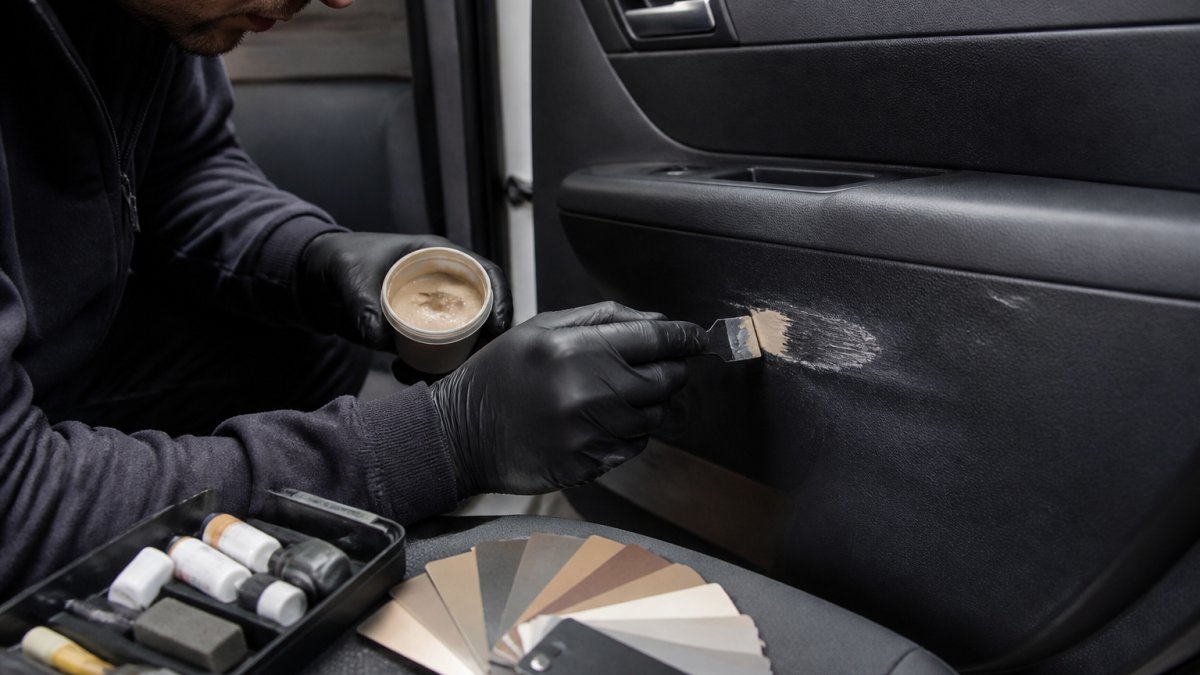
Step 1: Clean and Assess the Damage
Wipe the area with isopropyl alcohol and let it dry fully. This removes silicone from old dashboard sprays, which stops filler and dye from sticking.
Then look at the scratch under a bright light. Press the material gently. If it flexes and the cut opens, it is deeper than it looks.
Step 2: Match the Texture and Colour
Match colour first, texture second. Use your trim code or a swatch held directly against the surface.
Texture is the part most people miss. A smooth filler on a grained panel will catch the light and stand out, even if the colour is perfect.
Step 3: Fill, Blend and Seal
Apply thin layers of filler, building up slowly. Let each layer cure before adding the next.
Once level, sand lightly with a fine pad, then use a heat tool to press the grain back into the filler. Finish with a sealant to lock in the colour.
Expected result: the repair should disappear at arm’s length in normal light.
Car Dashboard Scratch Repair: Why It Needs a Different Approach
Dashboard scratch repair needs a gentler method because most dashboards have a soft-touch coating over hard plastic. That coating scratches easily and burns under heat.
So the rules change:
- Use less heat and lower settings
- Avoid aggressive sanding on coated surfaces
- Test every product on a hidden area first
A dashboard scuff that would polish out on a door card can smear on a coated dash. If the coating is already lifting, the honest answer is that a full recoat may be the only lasting fix.
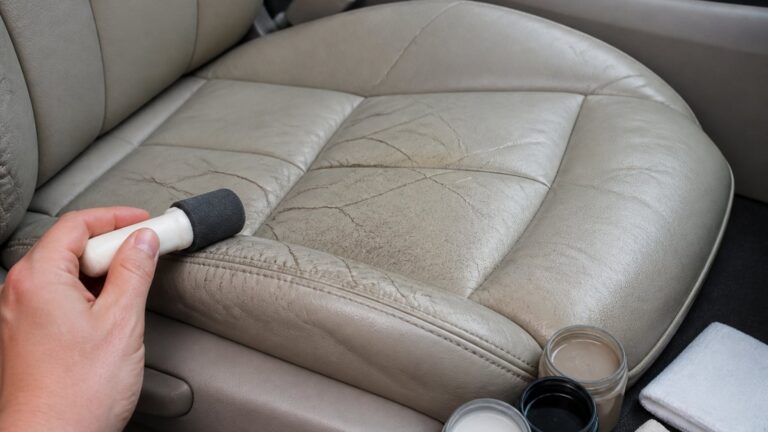
Leather Car Seat Scratch Repair: Colour Matching and Grain
Leather car seat scratch repair lives or dies on colour matching. Leather fades with sunlight, so the original factory colour is often not the colour on your seat today.
That means you match to the seat, not to the code. A repair mixed to the factory code will look wrong on a faded bolster.
Grain matters just as much. Real leather has a natural pattern, and a smooth patch on a grained seat is obvious. A good repair rebuilds that grain before sealing.
On leather, always match to the current colour of the seat and rebuild the grain before sealing. Colour alone is never enough.
Car Interior Scratch Repair Cost: What Affects the Price
Car interior scratch repair cost depends on the surface, the size and the number of panels involved, not on a flat rate.
The main factors are:
- Material: leather work usually costs more than plastic
- Depth: a deep tear takes longer than a surface scuff
- Colour matching: faded or unusual colours take more time
- Access: seats and dashes are fiddlier than door cards
- Number of areas: several small repairs in one visit cost less per repair
We do not quote blind. Pricing depends on what we find when we assess the damage, so get a quote based on your actual vehicle rather than a phone estimate.
| Damage Type | Typical Effort | What Drives the Cost |
|---|---|---|
| Surface scuff | Low | Size and access |
| Colour scratch | Medium | Colour match difficulty |
| Deep cut or tear | High | Filler, grain rebuild, sealing |
| Faded leather panel | High | Full colour match and recoat |
Mistakes That Make Interior Scratches Worse
The most common mistake is over-sanding. People sand a scuff flat, cut through the grain, and create a smooth patch that is far more visible than the original mark.
Other frequent errors:
- Using the wrong cleaner and leaving silicone behind
- Matching to the factory code instead of the faded surface
- Applying filler too thickly so it cracks as it cures
- Skipping the sealant so the colour wears off in weeks
- Using too much heat and burning the texture
Each of these turns a small repair into a bigger one. The pattern is always the same: too much force, too little patience.
If you have already tried a DIY kit and made the damage worse, stop before adding more product. Layered fillers on top of a failed repair are much harder to remove cleanly, and a professional may need to strip the area back first.
Repair or Replace? A Quick Decision Framework
Repair usually wins. Replacement is only worth it when the structure is gone, not the surface.
Use this to decide:
- Repair if the damage is cosmetic, the material is intact, or the item is valuable or hard to replace.
- Replace if the material is torn through to the backing, the foam is collapsing, or the panel is cracked and flexing.
For most scuffs, scratches and wear patches, repair costs a fraction of replacement and keeps the original finish. For a leased vehicle, a clean repair also protects you from end-of-contract charges.
If you are unsure, get an assessment. It is far cheaper than guessing wrong in either direction.
Frequently Asked Questions
Can scratches on car interior plastic be repaired?
Yes. Most scuffs and scratches on plastic trim, door cards and centre consoles can be filled, textured and recoloured so the repair is invisible. Shallow surface marks often polish out, while deeper gouges are filled with a flexible compound before colour is matched. A professional car interior scratch repair is usually far cheaper than replacing the panel, and the result lasts if the area is cleaned and protected afterwards.
Is it better to repair or replace scratched interior trim?
Repair is normally the better choice when the trim is structurally sound and only the surface is marked. Replacement means sourcing a matching part, paying for fitting, and risking a colour mismatch with the surrounding interior. Repair keeps the original component, takes far less time, and preserves the car’s factory finish. Replacement only makes sense when the panel is cracked through, broken at a mounting point, or no longer available in the correct colour.
Can you repair scratches on leather car interiors?
Yes. Leather car seat scratch repair involves cleaning the area, filling any split or lifted grain, then applying flexible colour matched to the original finish. Light surface scuffs can sometimes be reduced with a leather cleaner and conditioner, but cuts and deep scratches need a filler and recolour. Because leather stretches and flexes, the repair compound must stay flexible or it will crack again. A specialist can usually complete this at your home or workplace.
How much does professional car interior scratch repair cost?
Car interior scratch repair cost depends on the size and depth of the damage, the material involved (plastic, vinyl, leather or fabric), how many panels need work, and how much colour matching is required. A single small scuff costs far less than a full dashboard or multi-panel repair. Because every job is assessed individually, ask for a quote based on photos or an on-site inspection rather than relying on a generic figure.
A scratched interior does not mean a costly replacement. Whether it is a scuffed door card, a marked dashboard or a worn leather seat, the damage is usually cosmetic and can be made to disappear. At Uniqcare, our CRB-checked technicians repair leather, fabric, plastic and carpets at your home, with over 40 years of experience behind every job. Get a quote from Uniqcare and restore the look and value of your interior with minimum fuss.