Quick Summary
Mobile leather repair for car traders is a technician coming to your forecourt, storage site or preparation bay to fix interior damage on the spot, so vehicles don’t sit idle waiting for a workshop slot. Cosmetic damage such as scuffs, minor splits and faded colour can usually be repaired, while large tears and structural damage generally cannot.
- Worn leather can knock a buyer’s offer down before they look under the bonnet.
- Sort damage into surface marks, moderate wear and structural damage before booking.
- Press the area gently: stiff or brittle leather may not take a repair well.
- Photograph each area with a ruler or coin for scale and send photos with your booking.
- Build curing time into your handover schedule before moving vehicles back into stock.
Table of Contents
- Mobile Leather Repair for Car Traders: What the Service Covers
- Assessing Leather Damage Before You Book a Repair
- Car Leather Seat Repair: What Can and Cannot Be Fixed On Site
- How the Car Leather Repair Process Works, Step by Step
- Getting a Leather Repair Quote for Cars and What Affects the Price
- Car Interior Refurbishment for Dealers: Volume Work, Turnaround and Logistics
- Booking Your First Mobile Leather Repair Visit
- Frequently Asked Questions
Mobile Leather Repair for Car Traders: What the Service Covers
Last Updated: November 21, 2026
If you buy and sell vehicles in the West Midlands, worn leather is one of the quickest ways to lose money on a sale. A cracked driver’s seat or a scuffed steering wheel can knock a buyer’s offer down before they have even looked under the bonnet. Mobile leather repair for car traders means a technician comes to your forecourt, storage site or preparation bay and fixes interior damage on the spot, so the vehicle does not sit idle waiting for a workshop slot.
Worn leather on trade stock often shows the same kinds of problems: scuffs on bolsters, worn patches on seat bases, small tears near the seatbelt buckle and dull steering wheels. Some of these can be made presentable in a single visit, and some cannot, so a repairer should tell you before any work starts.
Leather repairs are generally cosmetic. Small scuffs, minor splits, faded surfaces and worn areas can be colour-matched, filled and refinished so they blend with the rest of the seat. Large tears, structural damage to the seat frame and heavily cracked leather that has lost its flexibility are generally beyond cosmetic repair.
Where the service fits well for traders:
- Preparing stock for sale or part-exchange
- Tidying up vehicles returned from lease or rental
- Fixing interior wear before a vehicle is photographed for listings
- Repairing damage without removing the car from your site
Assessing Leather Damage Before You Book a Repair
Before you book anything, check each affected area and sort the damage into three groups: surface marks, moderate wear, and structural damage. Surface marks such as light scuffs and scratches are the easiest to repair. Moderate wear, including faded colour, worn bolsters and small splits, can usually be restored. Structural damage, such as deep tears, cracking that goes through the full thickness of the hide, or broken stitching along a seam, often needs a different approach.
A simple check you can do yourself:
- Note the location, size and type of each mark.
- Press the area gently. If it feels stiff or brittle, the leather is cracked and may not take a repair well.
- Photograph each area from a few angles with a ruler or coin for scale.
- Confirm whether the leather is genuine, bonded or a vinyl-style finish, as the repair method differs.
Sending photos with a booking can help a repairer judge what is achievable before arriving, and it makes quotes easier to compare if you are speaking to more than one provider.
Car Leather Seat Repair: What Can and Cannot Be Fixed On Site
Car leather seat repair covers many kinds of work, but it is worth being clear about its limits. Scuffs, scratches, light tears, colour loss and worn edges on bolsters and seat bases are the sort of damage that can often be repaired on site.
If your damage falls into the second group, a replacement cover or a workshop repair may be a better option. Being told this upfront is far more useful than paying for a repair that will not hold.
For a deeper look at the repair steps for cracked leather specifically, see our guide on how to fix cracked leather car seats step by step. For scuffs that are not yet structural, our article on whether you can repair car interior scuffs at home explains when a home fix is realistic. If you are still weighing up what a seat repair can achieve, our full how to repair leather car seats guide covers the options in more depth.
How the Car Leather Repair Process Works, Step by Step
A typical on-site leather repair usually follows a similar sequence, whatever the vehicle.
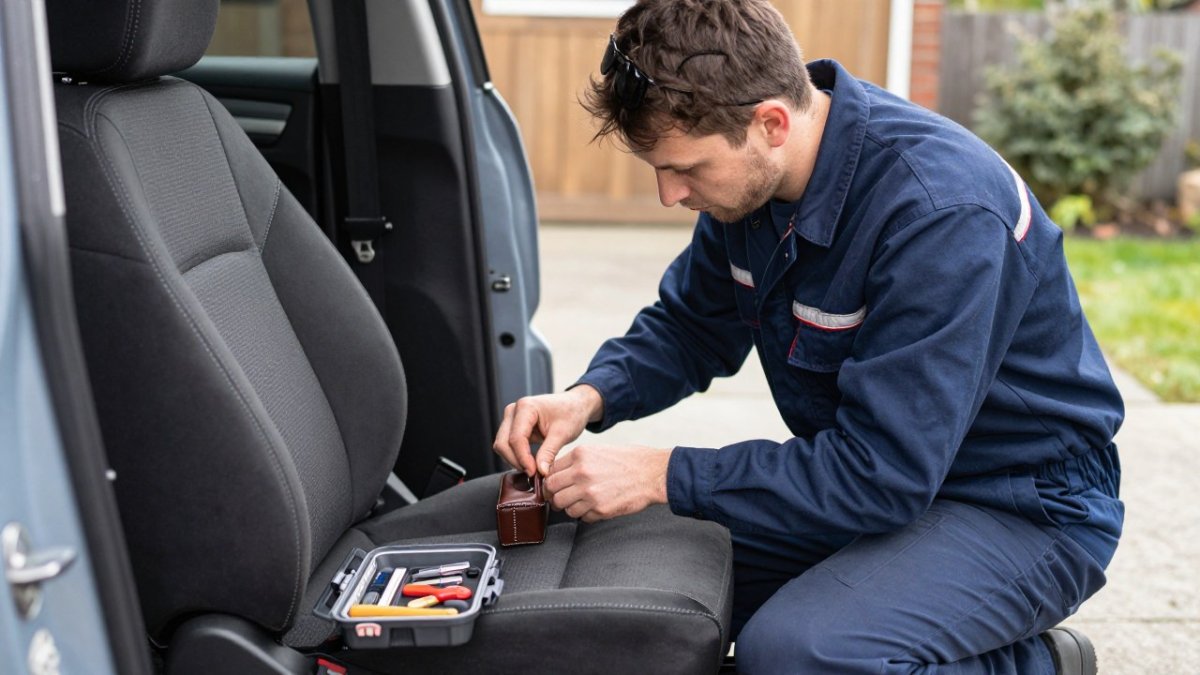
- Inspection. The technician checks each damaged area, confirms the leather type and agrees the scope of work with you.
- Preparation. The surface is cleaned to remove oils, conditioners and dirt that would stop a repair bonding properly.
- Filling and bonding. Small gaps and tears are filled and bonded, then allowed to cure.
- Colour matching. The colour is mixed to match the surrounding leather under the lighting conditions where the car is kept.
- Application and blending. Colour is applied in thin layers and blended into the surrounding area so the repair does not show a hard edge.
- Finishing. A protective topcoat is applied to restore the feel and sheen of the original surface.
- Curing and check. The repair is left to cure, then checked for colour, texture and flexibility before the vehicle is returned to use.
Curing time matters on a trade site. It is reasonable to ask how long a vehicle needs before it can be driven or handed over, so you can plan the movement of your stock.
This process is the same whether the work is on a single seat or across several surfaces. What changes is the time required. For a sense of how the work is structured for repairs of this kind, see our article on professional car interior scratch repair in seven steps.
The on-site repair follows a fixed sequence, and each stage has its own time and purpose.
| Step | What happens | Note |
|---|---|---|
| Inspection | Technician checks each area and agrees scope | Confirm leather type first |
| Preparation | Surface cleaned of oils, conditioners and dirt | Needed so the repair bonds |
| Filling and bonding | Small gaps and tears filled, then cured | Allow curing time |
| Colour matching | Colour mixed to suit lighting where the car is kept | Matches surrounding leather |
| Application and blending | Thin layers blended into surrounding area | Avoids a hard edge |
| Finishing | Protective topcoat restores feel and sheen | Restores original surface |
| Curing and check | Repair cured, checked for colour, texture and flexibility | Before return to use |
Getting a Leather Repair Quote for Cars and What Affects the Price
Pricing for leather repair depends on several factors, and any figure given without seeing the damage should be treated with caution. Current prices depend on the scope of work, so the best next step is to request a quote from Uniqcare’s website.
The main factors that affect a quote are:
- The number of affected areas and their size
- The type of leather or vinyl, and how easily its colour can be matched
- The condition of the surface and whether it needs deeper preparation
- How many vehicles are being repaired and how quickly they are needed back
- Travel to your site and the time needed on the day
A practical way to compare quotes is to ask each provider to price the same set of jobs on the same vehicle, which gives a like-for-like baseline. It is also worth asking whether a quote covers materials, travel and any follow-up checks.
Watch out: a very low per-vehicle rate can hide charges elsewhere, such as a minimum call-out or a materials charge added afterwards. Get all charges and any revisit terms confirmed in writing before the first visit.
For a single vehicle, travel and the first hour of labour often make up a large share of the cost; for a batch, the cost per vehicle can fall as travel and setup are shared. If you are weighing up whether repair is the right spend at all, our article on whether professional car interior restoration is worth it looks at how repair costs compare with the value they protect.
Car Interior Refurbishment for Dealers: Volume Work, Turnaround and Logistics
For dealers handling more than a handful of vehicles, the question can shift from a single repair to a repeatable workflow. Volume work tends to run more smoothly when the repairer knows your stock and deadlines, and when both sides agree how vehicles move through the process.
A workable volume arrangement usually covers a few practical points:
- Batching. Grouping vehicles by location and type of damage can help a technician work efficiently.
- Turnaround. Agreeing a target time per vehicle, and what happens if a vehicle needs more work than expected, helps keep a day on schedule.
- Access. Confirm where vehicles will be parked, whether there is power and water on site, and any site rules you must follow.
- Priority. Tell the repairer which vehicles are due for sale first so they can be scheduled accordingly.
- Records. Keeping a simple record of which vehicle was repaired, when and in which areas can help answer questions from buyers later.
Invoicing and repeat bookings are worth settling early. Agree the invoicing and payment terms and who on your side signs off each vehicle as complete.
Before committing to a volume arrangement, it is sensible to check a repairer’s relevant experience, insurance, examples of similar completed work, guarantees and service-area coverage for your sites.
Watch out: a very fast turnaround across a large batch may leave out preparation or curing time, and a finish that has not cured properly can fail later. Build curing time into your handover schedule rather than assuming a car is ready the moment the technician packs up.
Where you want a clear view of the financial case before committing, our article on whether professional car interior restoration is worth it looks at how repair costs compare with the value they protect.
Booking Your First Mobile Leather Repair Visit
When you are ready to book, prepare the following so the first visit runs smoothly:
- Photos of each damaged area with scale references
- A list of the vehicles, their makes and models, and their location
- The dates when each vehicle needs to be ready
- Access details for your site, including parking and any restrictions
- Any questions about colour, finish or limitations
If you are unsure whether a repair is suitable, you can ask a repairer to assess the damage from your photos first.
To discuss your vehicles or request a quote, contact Uniqcare for a quote. Share your photos and target dates, and the team can confirm what is achievable across your stock.
Uniqcare offers mobile leather repair for car traders across the West Midlands, with repairs carried out at your site by technicians who are fully CRB checked. Get a quote today to see what a repair could look like for your vehicles.
Frequently Asked Questions
What does mobile leather repair for cars involve?
Mobile leather repair means a technician travels to your site, whether that is a forecourt, a yard or a customer’s premises, and repairs damaged leather in place. The work can cover scuffs, small cracks, minor tears and worn patches on seats, steering wheels and door panels. Larger tears or heavily perished leather may need a workshop or a panel replacement instead.
Can a mobile technician repair scuffs, cracks and small tears in car leather?
Surface scuffs and light scratches are often among the easier types of damage to repair. Larger splits, areas where the backing foam has collapsed, or damage on a high-stress seam may need more extensive work. A proper assessment before booking can show which category your damage falls into.
What information should a trader provide when requesting a repair quote?
To receive an accurate quote, provide the vehicle make, model and year, the trim or interior colour if known, the number and location of damaged areas, and approximate sizes in millimetres or centimetres. Photographs taken in good light from several angles are very helpful. Note whether the leather is perforated or has a textured finish, and whether the vehicle is a lease or part-exchange unit that needs a specific finish. Also confirm how many vehicles you need repaired, since volume work is often priced differently. Contact Uniqcare for a quote and current pricing, which depends on the scope of work and quantity.
How long does a mobile car leather repair usually take?
Repair time depends on the number of damaged areas, the type of leather and how much curing time the finish needs. For trade stock, planning the repair around your sales schedule helps avoid delays. It is reasonable to ask for an estimated turnaround when you request a quote.