Last Updated: November 1, 2026
Quick Summary
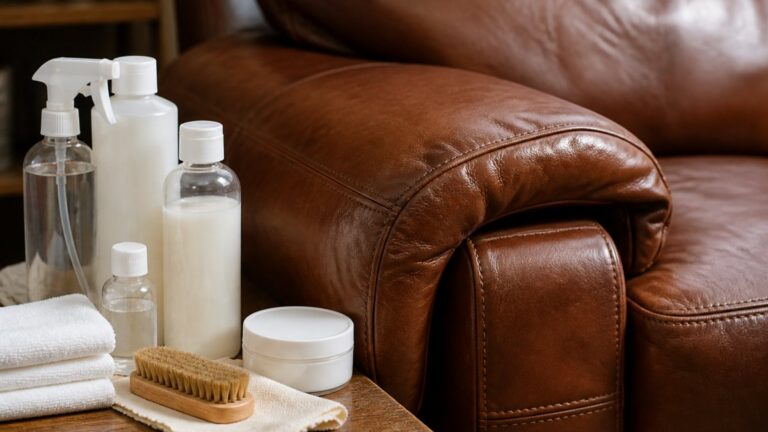
The top five leather conditioner brands for old sofas are Furniture Clinic, Renapur, Autoglym, Leather Honey and Gliptone. Match the leather conditioner to your sofa’s finish: water-based creams for pigmented or protected leather, and oil-based balms for aniline or semi-aniline hides after a 24-hour patch test.
- Furniture Clinic Leather Conditioner costs about £15-£20 for 250 ml and suits finished leather.
- Renapur Leather Balsam is an oil-and-wax balm for dry, stiff aniline and semi-aniline leather.
- Leather Honey is an oil-based liquid for heavily dried old hides at about £25-£30 for 236 ml.
- Condition leather sofas every three to six months if they are in daily use.
- Conditioner cannot repair cracked, peeled or torn leather, so professional restoration is the honest answer.
Table of Contents
- Why Old Leather Sofas Need a Different Conditioner
- The Top 5 Leather Conditioner Brands for Old Sofas Compared
- Choosing a Leather Conditioner for Old or Cracked Leather
- How to Clean and Condition a Leather Sofa Safely
- How Often to Condition Leather Furniture
- When Conditioner Cannot Repair Damage
- Get a Quote for Professional Leather Restoration
- Frequently Asked Questions
Why Old Leather Sofas Need a Different Conditioner
Old leather is not simply dry leather. It has spent years losing the oils and moisture that kept it supple, and its surface structure has changed.
Leather that responds best to conditioner is usually leather where the finish is still intact and the hide has simply dried out.
Three things change as leather ages:
- Loss of flexibility. The hide stiffens and starts to crease deeply rather than flex.
- Reduced absorption. A worn or sealed surface resists conditioner, so it needs a gentler, thinner formula.
- Colour drift. Aged leather darkens unevenly, and the wrong product accelerates that.
The lesson is straightforward. Match the conditioner to the condition of the leather, not to the label on the bottle.
The Top 5 Leather Conditioner Brands for Old Sofas Compared
Below are five conditioners that are widely available in the UK. They are listed by what they do best, because the right choice depends on your leather finish more than the logo on the tub. Prices vary with promotions, so confirm them with the retailer before buying.
Quick Comparison: Formula, Finish Suitability and Price
| Brand and product | Formula | Best for | Finish suitability | Typical UK price |
|---|---|---|---|---|
| Furniture Clinic Leather Conditioner | Water-based cream | Everyday maintenance on finished leather | Pigmented, corrected grain, protected | About £15-£20 for 250 ml |
| Renapur Leather Balsam | Oil-and-wax balm | Dry, stiff, worn leather | Aniline, semi-aniline, unfinished | About £18-£22 for 200 ml |
| Autoglym Leather Care Balm | Water-based balm | Protective top-up on coated leather | Finished and coated | About £12-£16 for 500 ml |
| Leather Honey Leather Conditioner | Oil-based liquid | Heavily dried old hides | Aniline and semi-aniline | About £25-£30 for 236 ml |
| Gliptone Liquid Leather Cleaner and Conditioner | Two-part kit | Heavily soiled old sofas | Most finished leathers | About £20-£25 for the kit |
Brand-by-Brand Pros and Cons
**1.
- Pros: gentle, easy to apply, good coverage, widely stocked in DIY and furniture retailers.
- Cons: limited restoring ability on very dry leather; you may need several light coats.
2. Renapur Leather Balsam. A beeswax-and-oil balm generally used on dry, stiff leather.
- Pros: strong moisturising effect, softens stiff panels, a little goes a long way.
- Cons: can darken aniline and semi-aniline colour, so patch test first; not for suede or nubuck.
3. Autoglym Leather Care Balm. A water-based balm aimed at coated and protected leather.
- Pros: gentle formula, good for protection, pleasant finish, easy to find on the high street.
- Cons: does not restore dry leather on its own; better as a top-up between deeper treatments.
4. Leather Honey Leather Conditioner. A thick oil-based liquid generally used for hides that have lost suppleness.
- Pros: deep moisturising, softens very dry leather, long-lasting effect.
- Cons: can darken colour noticeably, so patch test; slower to absorb and can feel tacky if over-applied.
5. Gliptone Liquid Leather Cleaner and Conditioner. A two-part kit that cleans first and conditions second.
- Pros: complete leather care kit, better absorption, good value for money.
- Cons: more steps, takes longer; the cleaner is not suitable for aniline leather.
If you are unsure which finish you have, test a hidden area with a drop of water. If it beads on the surface, the leather is protected or pigmented; if it soaks in and darkens temporarily, it is aniline or semi-aniline and needs a gentler, oil-based product.
How We Would Choose Between Them
For a finished, pigmented sofa that is simply dry, products such as Furniture Clinic or Autoglym are generally used. For an aniline or semi-aniline sofa that has stiffened, Renapur or Leather Honey are commonly chosen, provided you patch test for colour change. For a sofa that is dirty as well as dry, a two-part kit such as Gliptone can avoid buying a separate cleaner.
Choosing a Leather Conditioner for Old or Cracked Leather
The right conditioner for old or cracked leather is a thin, water-based or oil-based formula that absorbs rather than coats, applied after cleaning and always patch tested. Thick creams and heavy waxes tend to sit on cracked leather and make the damage more visible. But before you choose a product, you need to know what you are treating, and whether conditioner is the right tool at all.
Step 1: Identify the Leather Finish
Most old sofas are one of five types, and each tolerates different treatments:
- Pigmented or corrected-grain leather. The most common sofa finish. A polymer coating gives an even colour and protects the hide. It tolerates most water-based creams and balms, but conditioner cannot penetrate the coating, so it mainly conditions the surface and seams.
- Aniline leather. Dyed through with no protective coating, so it shows natural markings and absorbs liquids. It needs oil-based or gentle cream conditioners and should never be treated with silicone-heavy or solvent cleaners.
- Semi-aniline leather. A light protective coat over aniline dye. It sits between the two: use gentle, thin conditioners and patch test for colour change.
A simple home test: put a drop of water on a hidden area. If it beads, the leather is protected or pigmented. If it soaks in and darkens the patch temporarily, it is aniline or semi-aniline. If it sits on the surface without soaking in and feels plastic, it is likely faux or bonded leather.
Step 2: Assess Whether the Leather Is Dry or Damaged
Conditioner maintains leather; it does not rebuild it. Before you buy, check for these signs:
- Dryness: stiffness, dull surface, fine surface crazing that disappears when you flex the panel. This responds well to conditioning.
- Finish failure: the top coat flaking or peeling away from the hide, often at seams and armrests. Conditioner will not fix this; it needs recolouring or refinishing.
- Structural damage: cracks that are deep enough to catch a fingernail, splits, tears or exposed fibre. Repeated conditioning can soften weakened fibres and make cracking worse.
If you can see the suede-like underside through a crack, the damage is structural and professional restoration is the honest answer.
Step 3: Patch Test Properly
Apply a small amount to a hidden area, the back of the sofa or under a cushion, and wait 24 hours. Watch for colour darkening, tackiness, or a change in sheen. Aniline and semi-aniline leathers are the most likely to darken, and oil-based balms are the usual culprit.
Step 4: Match the Product to the Finish
- Pigmented, corrected-grain and protected leather: water-based creams and light balms. Avoid heavy oils that cannot absorb.
- Aniline and semi-aniline: oil-based balms and gentle creams, applied sparingly. Avoid silicone-heavy products, which leave a residue that traps dirt.
- Faux and bonded leather: products labelled for faux leather only. Do not use leather balms.
A common mistake is buying a heavy balm for a coated sofa. It cannot absorb through the finish, so it stays greasy and attracts grime. The reverse mistake, using a thin water-based cream on very dry aniline, simply does not do enough.
If your sofa is genuinely old and fragile, treat a small hidden panel first and leave it for a week before doing the whole sofa. If the leather feels brittle, or the finish is already flaking, stop and seek professional advice rather than applying more product.
When Conditioner Is the Wrong Tool
Conditioner is for dryness, not for damage. If the surface has cracked through, peeled or torn, no product will restore it. Cleaning, recolouring or professional repair is the correct next step, and our article on why leather furniture cracks over time explains what leads to structural damage and what can realistically be fixed.
How to Clean and Condition a Leather Sofa Safely
Safe conditioning starts with cleaning. Remove loose dust with a soft cloth, then work a small amount of leather cleaner into the upholstery in circular motions.
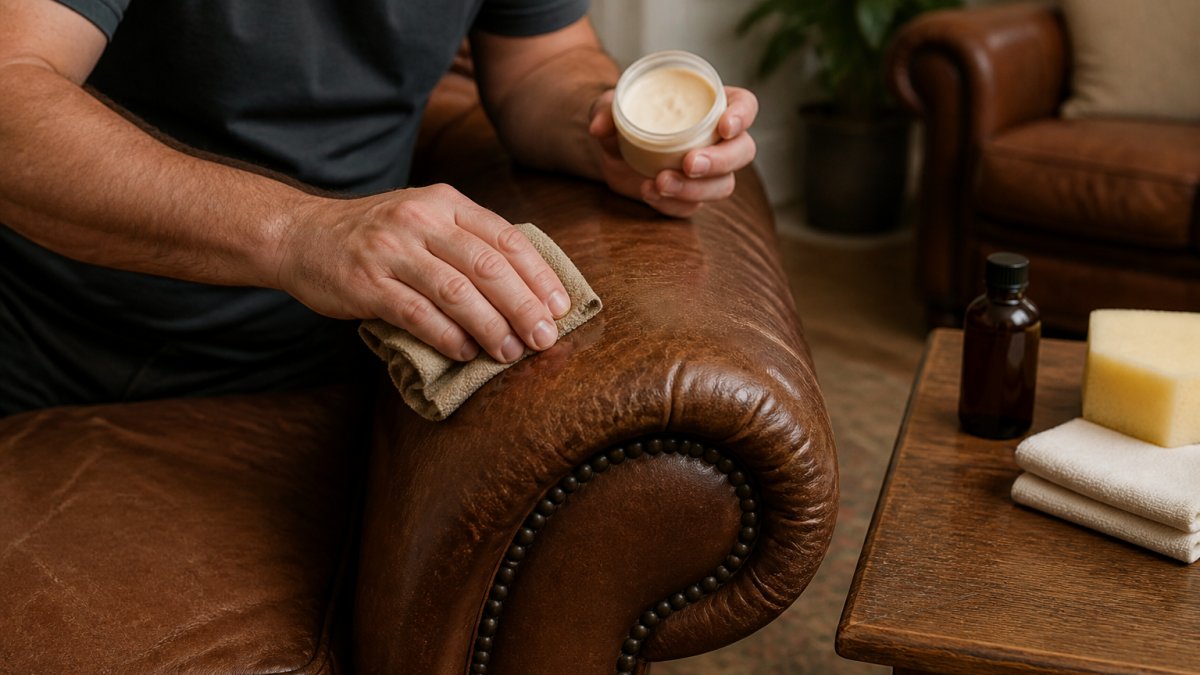
The sequence matters more than the product:
- Vacuum and dust the whole sofa, including crevices.
- Apply leather cleaner to a cloth, not directly to the sofa.
- Wipe off surface residue and let it dry.
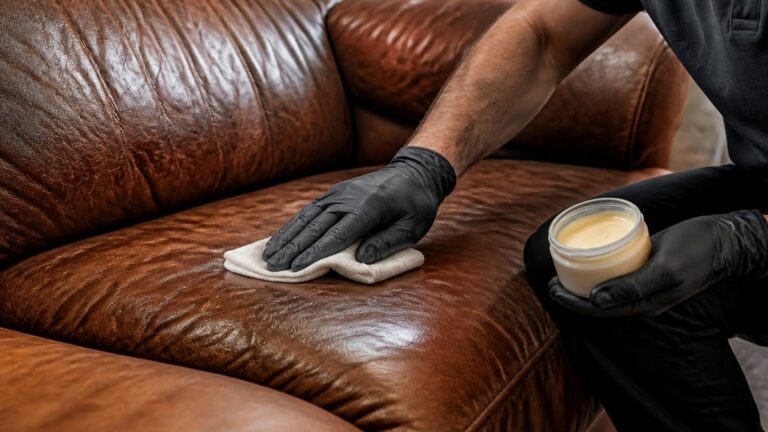
- Apply conditioner sparingly in thin layers.
- Buff off any excess after 10 to 15 minutes.
If you want tested product options before you start, our guide to the 7 best leather cleaners for home use shortlists suitable picks. For the full clean, condition and protect process, read our leather cleaner guide.
Watch out: applying conditioner to a damp or dirty sofa traps grime under the product and can leave a patchy finish that is difficult to reverse.
How Often to Condition Leather Furniture
Condition leather furniture every three to six months for a sofa in daily use, and every six to twelve months for furniture in a spare room.
Signs it is time to condition:
- The leather feels stiff or tight.
- Light creasing appears where the sofa flexes.
- The surface looks dull rather than supple.
Over-conditioning is a real risk. Too much product leaves a sticky film that collects dust. Two thin layers beat one heavy one.
When Conditioner Cannot Repair Damage
Conditioner maintains leather. It does not rebuild it.
The causes behind cracking are worth understanding before you spend more on products. Our article on why leather furniture cracks over time explains what leads to structural damage and what can realistically be fixed.
If your sofa has deep cracks, splits, or wear patches, professional leather restoration is the honest answer. Uniqcare’s technicians repair cuts, scrapes and wear patches at your home.
Get a Quote for Professional Leather Restoration
Before you commit to a restoration, it helps to know what professional work involves and what it costs. Our cost of sofa leather restoration guide sets out what drives the price. If you want to see how the service works, read how our mobile furniture repair works.
Our team has over 40 years of experience, and our technicians are fully DBS checked. We carry out repairs at your home.
If your sofa is old and worn, we can assess whether it is worth repairing.
Frequently Asked Questions
Can leather conditioner restore a worn or cracked sofa?
A leather conditioner can soften dry leather, improve suppleness and slow further cracking, but it cannot rebuild leather that has already split or lost its surface. Conditioner works best as prevention and maintenance on leather that is dry rather than torn. Where cracks have opened or colour has worn through, the damage needs filling, recolouring and sealing by a specialist. A patch test on a hidden area will show whether conditioning improves the look or whether restoration is the better route.
Is washing-up liquid safe to use on a leather sofa?
Washing-up liquid is too harsh for regular use on leather. It strips the natural oils that keep the hide supple and can leave the surface dry and more prone to cracking over time. A dedicated leather cleaner matched to your sofa’s finish is the safer choice. If you use a mild soap solution as a one-off, dilute it well, wipe with a barely damp cloth and follow immediately with a conditioner to replace what the cleaning removed.
How often should you condition a leather sofa?
Most leather sofas benefit from conditioning every three to six months, with older or dry leather needing attention closer to every three months. Sofas in sunny rooms or near radiators dry out faster and may need conditioning more often. A simple test is to press the leather: if it feels stiff rather than supple, it is due. Always clean first, apply a thin layer, let it absorb and buff off any excess.
Which leather conditioner is best for an old sofa?
The best leather conditioner for an old sofa depends on the finish. Aniline and unfinished leather absorbs oils readily, so a gentle natural formula suits it well. Pigmented and protected leathers need a conditioner that sits on the surface without darkening the colour. For cracked or fragile upholstery, choose a product with no solvents and patch test first. Matching the formula to the leather type matters more than brand reputation alone.
A worn sofa does not have to mean a replacement. If conditioning has stopped helping and the damage is visible, get a quote from Uniqcare. Our technicians repair leather, fabric and carpets at your home, match colour and texture for an invisible finish, and work with a cost-effective approach from £45. Get started with Uniqcare and restore the comfort and value of your furniture.